
Match Reports Across Systems
An event number, an arrest date, and a full name anchor the move from blotter row to source record. Keep the RPD wording exactly as written. Requests move faster when you quote it. Never stretch an event code into facts the bulletin never states. An arrest row calls for an arrest report. An incident row calls for public incident information. Treating an incident as an arrest sends the request down the wrong path.
The court file answers a different question. Search Person County in eCourts after the right person and case are clear. Prosecutors can amend or dismiss, so the filing may describe a charge differently than the police text did. Name-only matching invites errors, so compare arrest dates and any case identifiers before trusting the hit.
Detention records add a third layer. Entry and release summaries, detainee arrest sheets, and pretrial-release papers all follow the state sheriff retention schedule. Ask the county when jail processing, not RPD street activity, is the question. The schedule's three-year benchmark after release or transfer covers inmate-incarceration records. It sets no floor for web access. Protected details stay with the custodian.
Police Log Versus Jail Status
A dated bulletin is not a live custody roster. It arranges officer-completed reports around a date you pick. That helps you reconstruct a sequence of police activity in Person County. It cannot tell you who sits in jail today. Current custody belongs to the Detention Center, the legal outcome to the court docket, and all three dates should stay separate.
Compare Bulletin Dates Carefully
Treat a multi-day review as separate date checks. A continuous archive it is not. Note the selected date, event code, case number, and agency for every row. An event can surface after the day it happened. Officer-completed data may reach the bulletin late, so preserve both dates.
Do not read a crowded Monday page as a crime surge. A quiet weekend means just as little. RPD publishes no fixed holiday workflow. More rows can reflect report completion as much as raw activity, and online availability may end before the authorized retention period does. If an entry is missing, check adjacent dates before requesting the report.
Person County Dated Arrest Reports
The official Roxboro Police Daily Bulletin is the date-filtered activity source behind any blotter search. It carries a bulletin-date control. You also get an update function, an event-type filter, a printable view, and a code key. It works for one day or many. Never call it a fixed archive. RPD states no guaranteed depth.
The bulletin is an RPD product. It claims no complete list of arrests by the Person County Sheriff's Office, state officers, or agencies outside Roxboro. An entry tied to Timberlake, Semora, or another unincorporated community may belong with the sheriff, detention center, court, or county records portal instead.
The RPD Daily Bulletin page shows its date controls.
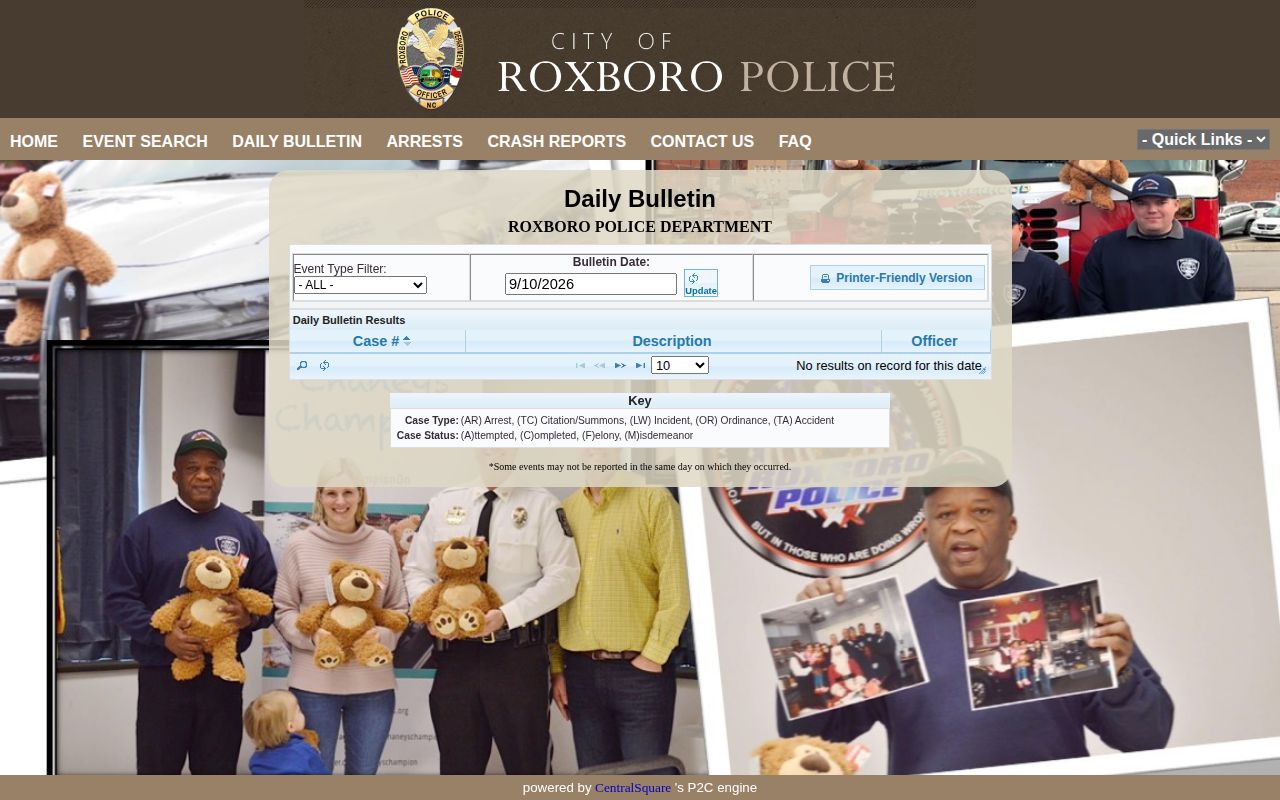
The interface must be filtered carefully because its rows are broader than arrests alone.
Read the Roxboro Police Bulletin
Start from a known incident or arrest date. Step backward or forward by date as needed. Report completion can place an event on the public system later than you expect. The printable view preserves a display for personal reference, though it never turns the page into a certified record.
- Open the Daily Bulletin and select the date to review.
- Use the event filter when available and isolate entries marked AR.
- Read the status and offense codes with the key rather than guessing.
- Open the associated event detail if the interface provides one.
- Check the Person County court record for the later disposition.
For a current card, use Arrested Today. That page covers RPD's separate Recent Arrests module. It also explains why the module is no exact 24-hour or countywide feed of arrests in Person County.
Person County Bulletin Codes
An activity row is not automatically an arrest report. RPD's key names the event class. Separate status abbreviations describe how each event was recorded. Read the two label sets together before treating a row as an arrest in Person County.
| Code | Bulletin meaning | How to use it |
|---|---|---|
| AR | Arrest | Use this to isolate police arrest activity. |
| TC | Citation or summons | Do not recast it as a custodial arrest. |
| LW | Incident | An incident listing may not identify an arrest. |
| OR | Ordinance | Treat it as its own event category. |
| TA | Accident | It belongs to traffic-accident activity. |
| Attempted/completed | Event status | This is not a court disposition. |
| Felony/misdemeanor | Charge classification | Verify the filed and final charge in court. |
The official RPD Daily Bulletin FAQ treats officer-completed report data as a North Carolina public record. It says that data is offered for public review.
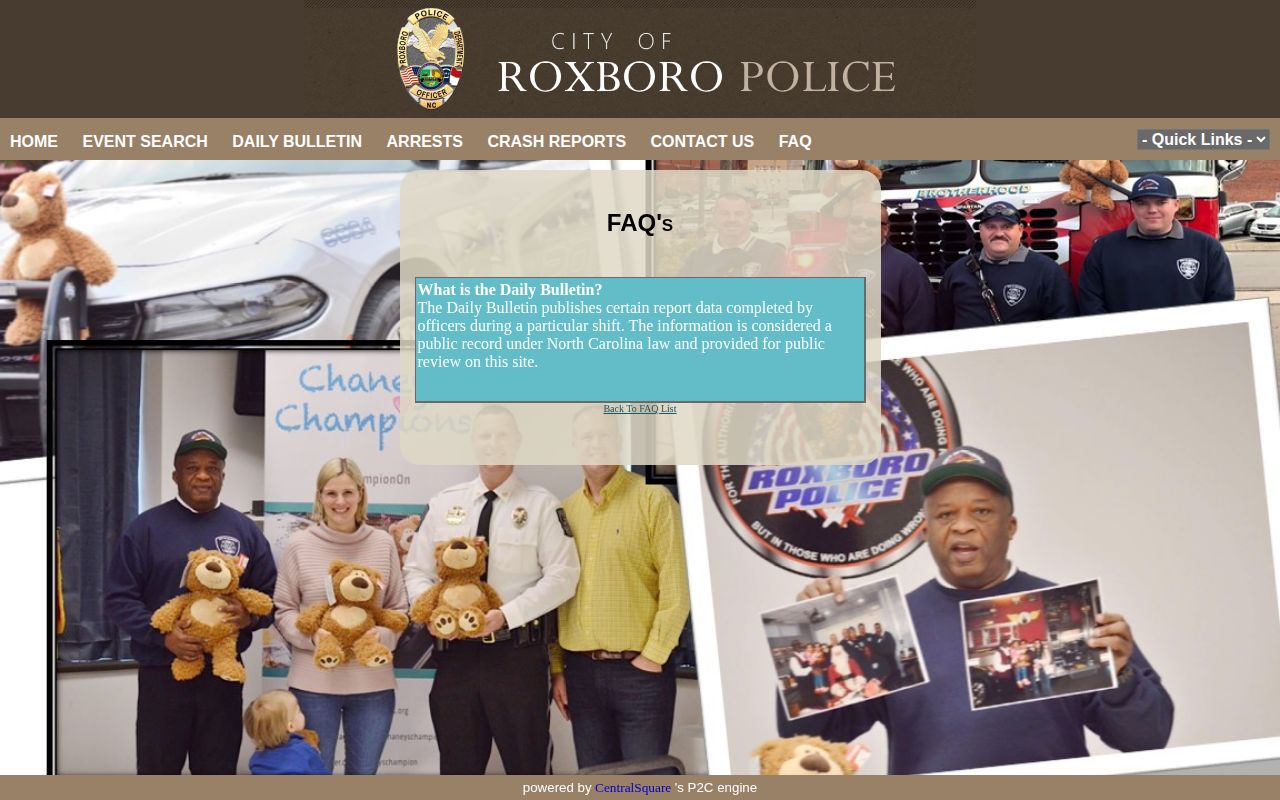
The FAQ also separates event timing from report completion.
What an Arrest Report Contains
What you see in a public bulletin is only part of the file. The full arrest report can hold much more. North Carolina's sheriff retention schedule lists the possibilities: a full name, aliases, residence, sex, age, date of birth, and a physical description. It may also include the offense, vehicle details, phone numbers, witnesses, and the arresting officers. Some of that never reaches the public page. Sensitive identifiers get restricted or redacted, and rightly so.
Under N.C.G.S. §132-1.4(c), the public side of an arrest includes the time, date, location, and nature of the apparent violation. The statute also makes certain identifying details public. The rest of the criminal-investigation file sits under a different rule. Returned warrants and similar process can be public unless a judge seals them. Even so, nothing guarantees every item lands in the bulletin.
- Arrest report
- The agency record documenting an arrest and related facts.
- Blotter
- A chronological public activity listing that can include more than arrests.
- Disposition
- The court’s resolution of a charge, which may differ from the booking charge.
Older Person County Arrest Records
How far back does the online bulletin go? No official retention depth is posted. When an older date will not come up, send a focused request through the Person County Open Public Records portal. Name the person, the date range, the agency, an event number if you have one, and the exact arrest report or booking material you want. For RPD items, the arrest-report FAQ is another official door to try.
Retention and website availability are two different things. The North Carolina State Archives schedule lets a stand-alone arrest report be destroyed five years after the arrest, if it never joined a case file. Arrest-processing tracking records carry a one-year benchmark. DWI tracking lasts two years, and inmate-incarceration records three years after release or transfer. Case files can run longer. A pending audit or litigation blocks destruction. Keep in mind these are permissions to destroy, not promises that any online log spans them.
For local reporting context after the official sources, the Person County Life and Courier-Times is worth a look.
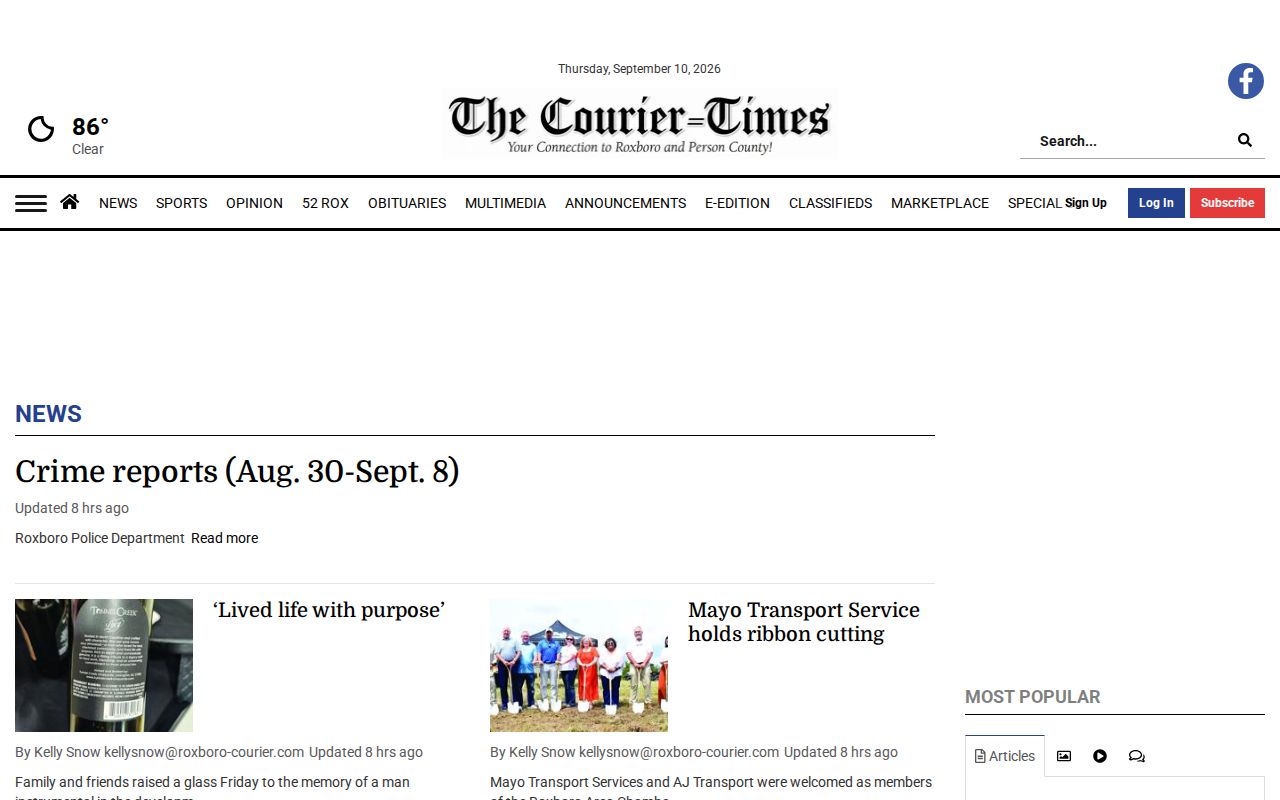
Note: Person County Life is an independent news outlet, not a police log, so its arrest details may be selective or later corrected.
Verify Report and Custody
A dated police event tells you little about who is still in custody. The Person County Detention Center posts no public current-custody roster on its pages. For a live answer on anyone arrested, call detention at (336) 597-0525. The main sheriff's office sits at 120 Court Street, Roxboro, NC 27573, reachable at (336) 597-0500.
After an arrest, the case moves to court. Check the North Carolina eCourts Portal to follow it there, since court records track the charges as they develop. For custody alerts, VINE Arrest Check explains how the notification system works, though Person County's participation is not listed. State prison, probation, and parole questions go to the NCDAC Offender Public Information Search, which excludes county-jail data.